skip to main |
skip to sidebar
 Lightweight. That was my instinctive reaction to this Booker Prize winner. There was nothing intrinsically wrong with the book, and in fact, I read it in two short sittings, putting it down only to watch the warm up game at the WACA.
However, no major flaws does not a prize-winner make, in my estimation. The tale is appropriately poignant, and that's where it seems to fall down. It's almost as if the entire story is crafted in order to pointedly engage a particular audience, and that manufactured feel is what stopped me from liking it a lot more.
The narrative is solid, and the prose engaging but not spectacular, and anyone who enjoys fueling a stereotype (which may well be accurate, in this case) will appreciate it.
If you are drawn to tales of an exotic yet down to earth reality in which caste, creed and basic human instinct are fundamental, then this is for you. Even more so if that is your carefully cultivated image of the India that you only ever get to see the periphery of, the one that you are sheltered from in your five-star hotel and luxury lifestyle. And that, no doubt, is why Adiga now has the Booker Prize.
Read it. Enjoy it. It's a good book. Insightful, even, if you're not already overexposed. Just don't be fooled into expecting great literature.

I've written about how poor Viv Richard's autobiography was. I've pilloried Prabhudesai on Dravid, enough to receive a long and impassioned defense of his work from the author (material for another post someday). Steve Waugh's epic was sadly, decidedly within his comfort zone. Generally, sporting biographies and autobiographies turn out to be as banal as can be.
With that in mind, I wasn't impressed when my wife spent a few dollars on Mike Hussey's book - and yet here I sit today, complimenting her on her astute choice.
For once, we have a book by a cricketer that actually talks about what it means and what it takes, to be the cricketer that he is. It is open, honest and insightful, and apart from a few graphics to illustrate how good a cricketer Hussey actually is, everything in it is information I cannot glean from elsewhere. I actually feel like I learned something from the book, not just about Hussey and his struggle to the top, but about myself as well.
Sure, he doesn't have the literary skills of a Dumas or a Mitchell, but boy does he deliver some meaningful content. I would countenance any young player looking to make his way in the game to read this. Hussey's methods may not be for everyone, but there's little doubt that this book can be a tremendous guide to anyone.

I observed back when I read Black Swan Green that David Mitchell appeared to be a prodigiously talented writer. Now that I've read Cloud Atlas I can safely say that my original assessment was a massive understatement and I did Mitchell a great disservice. I don't even know where to begin to describe the masterful tapestry that he has woven, so I won't.
It shall have to suffice to say that he has got to be one of, if not the, most innately talented authors I have ever come across. His mastery of each of the half-dozen completely different voices that he adopts is quite incredible, and the only reason it took me more than one night to read the book was the fact that I had to get up early each morning to drive down to the WACA for the small matter of a Test match.
One contrarian caveat that I must throw in here for clarification. The book itself I found to be excellent, but I'm not sure it's really an all-time-great novel in my own estimation. It's up there near the top of modern literature to be sure, but I'm not sure I'd even rate it above one of my other recent reads, The Time Traveler's Wife.

Perhaps it wasn't wise to read For One More Day right after Cloud Atlas, but in any case, I'm simply glad that I didn't actually spend money on this book. There's nothing egregiously bad about it, but it didn't particularly have anything going for it either. Repetitive and thus predictable, it smacks of a short story masquerading as a novel. An author can pull that off, if he has the sort of literary skills that Mitchell possesses. I suspect even Mitch Albom fans would struggle to say this was a really great piece of work.
 The Inheritance of Loss was an interesting read, mostly in that I really struggled to figure out where the author was coming from. Astonishingly, there wasn't a single positive character in the book. Every one of them was in some way a pathetic caricature, and I use that word to emphasise the lack of depth that often existed. Oddly, I found myself wanting to skip chunks of text, and yet continue reading - perhaps an indication that Ms Desai's writing didn't resonate with me, but that the story that might have been told, did? Again, nothing terrible about the book, but not one I'd particularly recommend, and I am stunned that it won the Booker prize! An almost very good book that didn't quite make it.

Jasper Fforde, take a bow. I've been wanting to try Fforde out for a long time, and I finally took the plunge. The Eyre Affair is outrageous stuff, and pure entertainment, but in a quality, rather than cheap way. Light, yet sumptuous, and oestensibly trite, yet captivatingly brilliant. No question I'll be reading his entire collection now, and if you are into your literature, but also enjoy suspending disbelief, then I have little doubt that you will love the neither utopian nor dystopian world that Fforde has created.
A few of my better recent reads:
- Anne Fadiman - The spirit catches you and you fall down

- Wasn't sure what I was going to get here, but it turned out to be a touching story and I was riveted. First of all, it was a specific story of a culture and people that I knew nothing about, and was therefore happy to get an introduction to. It was also a harrowing tale of a poor young girl suffering from epilepsy. But more than both of those, it was a surprisingly insightful revelation of an experience that could be transposed onto any diasporic community. It just goes to show that for all our differences, things are so much the same for all of us on a fundamental level. There's so many levels on which to read this book - all of them valuable and enjoyable.
- Michael Chabon - Kavalier and Clay

- An excellent read. Everytime I felt it was dragging on, it shifted, which said to me that the author paced it just right. There were definitely points at which I worried that it would be descending into political propaganda, but it never quite did. I look forward to reading more about a Yiddish policeman.
- Audrey Niffenegger - The Time Traveller's Wife

- So I'm a sucker for time travel, so much so that I'm the person that thinks Journeyman is the only show on TV worth watching, apart from Heroes. I really couldn't lose with a book like this. And I didn't. Right at the top of my list, for the time being, at least. What really blew me away was how effectively Niffenegger managed to develop the plot and the central characters, despite operating in a chronologically challenged environment. We may have jumped back 30 years from chapter to chapter, but the individuals always progressed in our minds.
- Mark Haddon - A Spot of Bother

- Curious Incident was superb. I really felt like I was inside the mind of an autistic child, not that I have any idea what that would actually feel like. Haddon's follow up, "A Spot of Bother," is not perhaps on that level, but he has given us another wonderfully quirky, amusing and yet profound glimpse into a dysfunctional world. I hope I don't have to wait too long for the next one. He's on my must-read list now.
- Harry Thompson - Penguins Stopped Play

- Superb. If you play cricket at all, and know how to read, pick up a copy of this one! One of those that really resonated with me - I could pick out characters in my own cricketing experiences that matched up with every member of the Captain Scott squad. If you don't know who Thompson is - he's one of the creators of Ali G, and as such instrumental in the discovery of Sacha Baron Cohen. He also helped put guys like Ricky Gervais and Harry Enfield on the map - a real comedy legend!

I guess it's fashionable to rave about this book. Fortunately, it's also fashionable in some circles to be contrarian, so I'm not going to be completely out of favour after this brief comment.
They say economics is the science of incentives. I'd go a step further and say it's the science of common sense. The concept that is the foundation of economics is that of supply and demand. If you want more of something that is in scarce supply, it'll cost you. If you don't want something that is available in abundance, you can get it on the cheap. Your first year of economics in high school will focus on that - and if you ask me, if you didn't realise it already, you're doomed anyway.
As far as Freakonomics goes though, we've moved one level lower - to the science of statistics. In the famous words of Aaron Levenstein, "statistics are like bikinis. What they reveal is interesting. What they conceal is vital!" Ironically, that's essentially what the authors claim about other peoples statistics, only to go and fall foul of the same issues themselves.
Are swimming pools really more dangerous than guns? Is flying safer than driving? Is the crime rate lower today because of Roe vs. Wade? Is having an intact family unit and reading to your child totally irrelevant? The same stats that the authors use to supposedly prove one side of each of these and many other questions, can be used to prove the inverse.
So in the ultimate analysis, the book is an entertaining read, but not necessarily insightful. In fact, I couldn't shake the feeling that it was in part an excuse to espouse a particular set of beliefs, under the guise of scientific fact.
Read it, if you haven't already. You'll have a good laugh, and if you're not an open minded thinker, it might make you aware that there are many ways to skin a cat.

Of course, many would say that marriage in it's entirety tends to rest on a pretty fine edge, but that's neither here nor there.
This book is, of course, a collection of short stories. As I've repeatedly said, I am not the biggest short story aficionado out there. So when I say that this is actually a pretty good read, that's not just damning with faint praise.
I still faced my usual frustration with the lack of any sort of closure, cliched or otherwise, in most of the stories - though the final pair of tales surprised me by winding up in some sort of a settled state. However, what set this collection apart from most for me was the fact that without fail, the stories were gripping. I don't know that Kaplan is a great writer, but she did a tremendous job of capturing the relationships she was describing, and the state of mind of her key characters.
Don't go out of your way - but if you come across the book, pick it up and you won't be disappointed.

WARNING - Some of the following may spoil the plot, although I'll try and avoid doing so in too significant a manner.
So I consoled myself over the loss of "War Reporting for Cowards" by reading the same book that 350 million others have been reading over the last week or two. While I don't really have anything overwhelmingly negative to say about the experience, I am thankful that I am a fast reader and it only took me about 6 hours to get through it.
I walked away from the book (well, more like turned out the light and went to sleep) with two clear lingering thoughts.
First of all, all the pre-book speculation about people dying turned out to be both right on the mark and wildly off base (how's that for avoiding spoilers). Deaths were somewhat gratuitous and insignificant, and yet were of the sort that students of literature fifty years from now will deem to have been central to plot advancement and critical to character development (at least, for those characters who remained alive, that is).
As for the grand denouement and the climactic scenes leading up to it, in truth I think many readers will find themselves surprisingly unsurprised. It seems to me that Rowling either unwittingly backed herself into a corner with the previous books, or else had always known how things would unfold, and revealed more than she really intended. That, or my guesses happened to be good ones.
As her characters have grown from book to book, Rowling's writing has clearly evolved with the series. The books are still a light read, as they should be, but she has done well with this one to keep me engaged despite the lack of suspense - I cast my mind back to the first book, which took me several attempts to plough through because it was simply not well written.
Can't really say much more without spoiling it for my two readers, so I won't.

I would tell you what I thought of this book, but unfortunately the bloody thing was last seen sitting in seat 2D of a United Airlines 737-500. Ironically, I'd just got through the first half of the book, which was the real scenario-setting, character-developing piece. I typically like to read on a flight, but my seatmate this time was a bloke with a rather recognizable name who runs a several hundred million dollar jewellery business, and that's a world just so far from my own that I couldn't help but engage in conversation. Still, I wish I had my book back!
It's certainly not a prize-winning work of non-fiction, but it was a gently irreverent look at 9/11, Iraq and the impact on everyday life. You won't swear by it, but you'll enjoy the read - and when you're done, please send the book my way so I can finish it!
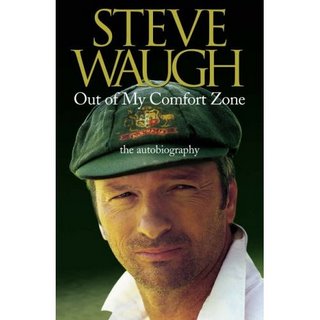
Well, reading that certainly took me out of my comfort zone. It wouldn't even be far-fetched to say that the two best things about the book were the afterword by Lynette Waugh, describing life as a cricket widow, and the pictures.
I'd looked forward to this one for a while, albeit with the sort of apprehension that I once reserved for War and Peace as a precocious twelve year old. Turns out that Tolstoy spun a far greater yarn, and probably provided just as many insights as Waugh did into what made the Australians tick in the late 90's and through the turn of the century.
I've railed about the Prabhudesai biography of Rahul Dravid, but this was really only marginally better. The details of the odd on-field sledge aside, there just wasn't much in there that I didn't already know. There was little to help us understand the man, or his achievements, both as a player and as a leader.
There was even less when it came to his relationship with brother Mark - and you'd think a cricketer would have something to say about someone he played 108 Test matches alongside. I suppose the fact that most other teammates were referenced by first-names and nicknames, whereas 'Junior' was always referred to as 'Mark Waugh', tells a story in itself.
Bottom line - don't waste your money or your time.

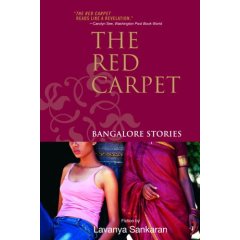
I was at my brother's place a few weeks ago and noticed this sitting on the bookshelf. It's been at the back of my mind for a year and a half, ever since the author's brother mentioned it to me, and I figured I now had no excuse. Ironic, I suppose, that despite not being a short story aficionado, I wound up with two collections to while away the early mornings at the WACA!
I have to say that I infinitely preferred this lot to the Munro collection I read immediately prior.
At first glance, one would think that the stories would be best appreciated by someone who could directly identify - that is to say, a member of the modern-day South Asian Diaspora (with a nod to all you SSAMD members out there!). However, despite the fact that I've never lived in India myself, and couldn't directly identify with all the specific experiences, the underlying themes never failed to resonate.
The characters and stories were all lively and vibrant. I enjoyed the cross-pollination, with different aspects of individual characters being drawn out in different stories, sometimes as the central protagonist, and othertimes as the comedic side-kick. I doubt it was the author's intent, but for me this served to satisfy my innate need for trite endings and resolution in a short story, without actually reverting to either.
It could be said that the stories themselves are cliches - but against that, I would counter that that's precisely the point. It's the stark realities of those cliches that gets us reflecting and questioning, and any writer that can make us do that is onto something.
Several of the stories could easily be transformed into a novel in their own right. An exploration of the relationship and parallels between the Indian and American worker (I forget which short this was in) certainly would provide plenty of fodder. I'm looking forward to seeing what Sankaran comes out with to follow-up, given that it's often the second and third works that tell us where a writer is really going to go.
Next on my reading list: Iain Aitch's "A Fete Worse than Death" in which he reputedly sees Bill Bryson, and raises him some.

Apart from my collection of cryptic crosswords, I had some time whilst waiting in the queue at the Test match to read a couple of books that I recently acquired.
The first of these was Alice Munro's collection of short stories - Runaway. Fans of Munro swear by her work, and she came to me highly recommended. I've never worked out what I think of short stories. The ones that come with resolution, all neatly wrapped up, tend to be cliched, almost formulaic. The ones that are creative and well-written, tend to leave me unsatisfied. I suppose different styles work at different times.
Runaway definitely fell into the latter category for me. Much like the fast bowler who beats the outside edge half a dozen times, but never actually picks up a wicket, this collection of stories repeatedly introduced me to intriguing characters, but left me wondering what exactly happened to them. I suppose that's the inherent strength of the work. Munro certainly is a master of her craft.
I won't say no if another Munro crosses my path, but if truth be told, I won't be seeking them out either. There's plenty of reading material out there, and this just isn't at the top of my list.

I may have lived in Hong Kong at the time, but my adolesence and schooling was as quintessentially English as they come. It's perhaps for that reason that Black Swan Green struck several poignant chords with me. Memories (the vast majority of them very fond ones) of P.E. lessons and playground games of British Bulldogs came flooding back. I can almost feel the cuts, scrapes and bruises when AB sent me sliding across the concrete and into a partially barbed fence - all part of the game, of course!
The tale of typical adolescent angst, set in a truly nondescript English village, is constructed as a series of entertaining vignettes, each independent, yet threaded together to span a calendar year in which a teenager has his life turned upside down and inside out from every angle, and yet manages to somehow use it all to come of age, as such.
Much like The Essence of the Thing, at the end of the book, I wasn't entirely sure what it was about, given that there wasn't much that you couldn't see coming after the first chapter. And yet once again, I was hooked, read it cover to cover, and was entertained throughout.
Many critics panned it as being too conventional a tome, and consequently overly ambitious for David Mitchell - ostensibly paradoxical, but then I haven't had the pleasure of reading his prior work. As far as I'm concerned, it did more than enough to hint at, without fully revealing, an exceptional literary talent, and the reputedly more complex and more cerebral Cloud Atlas has found a place on my wish list as a result.
P.S. - for those who are wondering, I'm not turning this into a book-blog per se. Lots of work-related travel of late has left me with little time for spending online reading and blogging about the usual stuff.
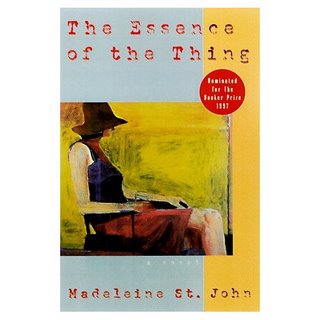
A funny one, this. I read it, and enjoyed it, and yet I have absolutely no idea what the essence of the thing is. In fact, the books essence is almost that there is a Seinfeld-esque nothingness about it. An interesting literary style, to be sure. The dialogue, which dominates the narrative, is occasionally witty, often snappy, and always compelling, in so far as it provides for a surprisingly vivid portrayal of character. The plot itself managed to be strangely irrelevant, and yet, as a friend with nothing better to do just pointed out, the notion of individuals failing to accept or embrace the freedom they have been granted is eerily topical. Witness Iraq.
All in all, a good read. I might just have to give her follow-up, "A Stairway to Paradise" a go.
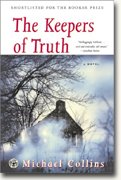
Someone left this book behind at my place for me to read a couple of months ago. Last week, I finally got around to it. Shortlisted for the Booker Prize, it said, so I went into it with the expectation that it would be a halfway decent read.
It wasn't, at least, not in my estimation. Granted, the fact that it's a bit of a depressing and somewhat allegorical tale doesn't help matters, but the idea that "the times, they are a-changin'" is hardly a novel one. Nothing particularly bad about the book - quite simply it just failed to capture my imagination or engross me on any level. Didn't work as a whodunit, and didn't quite work as a cautionary tale of cultural demise either.
Next on my list is "The Essence of the Thing" by Madeleine St John and the epic "Out of My Comfort Zone" by one Stephen Rodger Waugh. Something tells me I'll have better luck with both of those.
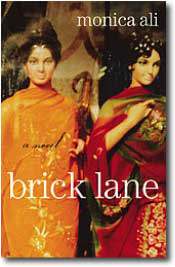 For the last three years I've read and heard about how Monica Ali could be the next big thing, and now that her second work, Alentejo Blue, is finally out in print, I figured it was about time to go ahead and read the much-hyped Brick Lane. Last night, I did just that. It managed to leave me overwhelmingly underwhelmed, and yet I sacrificed much-needed sleep to finish it, so it can't really have been too bad.
A review I once read described her prose as being "unflamboyant," and that turned out to be a euphemism for mundane. Perhaps the hype raised my expectations too far, for this was not The Da Vinci Code, but neither is Ali a wordsmith par excellence.
The fundamental premise of the novel, an exploration of fate and free will, if somewhat unoriginal, is still an interesting one. Anyone who identifies with a diasporic community, and the challenges faced by generations of immigrants, will find plenty to relate to in Brick Lane, in both obvious and more subtle ways. A daughter wearing tight jeans - well we've seen that one before; but the husband framing his cycling proficiency certificate was at least a new spin on an old story.
Most of the formal reviews of Brick Lane have been very generous, almost sycophantically so in some cases. To be fair, there are some aspects of the novel that few would disagree were handled well. For example, the way that Ali pointedly avoids any exploration of the local geography, as if to illustrate the tight confines within which many immigrant families operate such that they are able to imagine that they are back home where they feel they truly belong. Also, the use of religion, in a non-judgemental fashion, as a guiding force for the majority of characters, albeit in differing guises.
Ironically, the construct that truly kept me turning the pages was the one that has been most criticised by both 'expert' reviewers and the general public - the letters from the protagonists sister, Hasina, back in Dhaka. They were intelligently used as a means for chronological advancement of the plot, but for my money their content was integral to both the story, and my enjoyment of it.
They managed to provide a sort of tragi-comic relief, while simultaneously allowing us to connect the two worlds, and further our understanding of the events leading up to and including the (not entirely) climactic moments. The way in which Ali used broken and twisted language really helped build on everything from character to culture and social structure, and those nuances were furthered by Hasina's philosophically astute and sophisticated observations of her world. Those thoughts were shrouded in a veil of simplicity and naivete, but much like the forthright statements of a five year old who does not neccessarily appreciate the inherent complexities of what he is considering, they succinctly and comprehensively depict an entire scenario.
Overall, a decent read, but neither well enough written nor constructed to genuinely move or impact me. Of course, the last book I read that really achieved that was The Kite Runner, so the bar is set pretty high.
I'm in the middle of reading "The Nice Guy who finished first" - Devendra Prabhudesai's biography of Rahul Dravid. It is, not to put too fine a point on it, a complete and utter waste of time. There is absolutely nothing in it that gives me any insight into the boy, the man, the cricketer, or even the game. The author has apparently gone through the scorecards of every game Dravid ever played, translated them into prose, and stuck in a few quotes from other published media sources. There is barely even an attempt to tie it all together, other than the mundane chronological procession that the reader is walked through. It ranks right down there with one of my greatest disappointments of all time - Viv Richards' autobiography.
Why is it that cricketers, and indeed most sportspeople, struggle to produce books worth reading? Their stories are at worst remarkable, and at best unbelievable, and yet so rarely does any of that come through, be it biography or autobiography. If I wanted to read the scorecards, I would do just that. Wisden has that one covered, both online (CricInfo) and offline (the almanack). I read these books to understand what made these men different. What made them tick. What is it that made them who they were. I know the facts. I want the story.
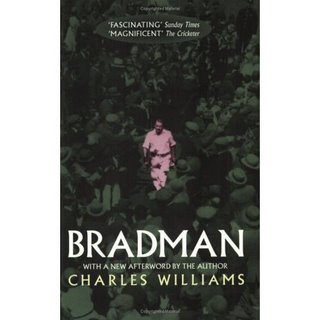
As I've often said, the best biography ever written, in my opinion, is Charles Williams' "Bradman" which tells the story of a man who united a nation, giving it hope and identity. The statistics are incidental. The man, and his story, are integral. And that's how it should be.
 Lightweight. That was my instinctive reaction to this Booker Prize winner. There was nothing intrinsically wrong with the book, and in fact, I read it in two short sittings, putting it down only to watch the warm up game at the WACA.